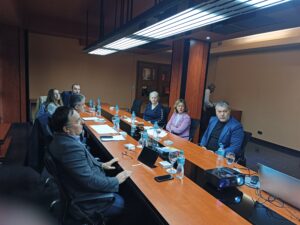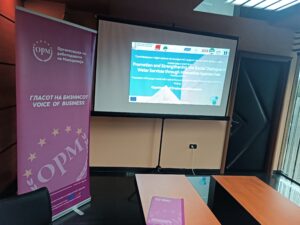


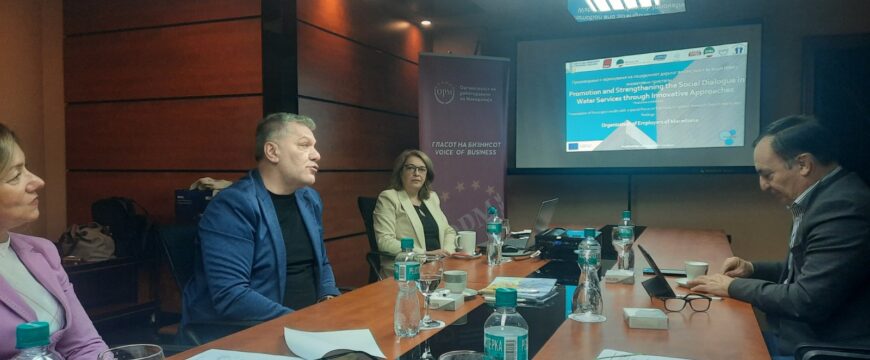
The Organization of Employers of Macedonia (OEM) presented a key study on social dialogue and the situation of the workforce in the water supply sector, conducted within the framework of the project “Promoting and strengthening social dialogue in the water sector through innovative approaches” ProSDinWater, funded by the European Union. The research covered four participating countries – North Macedonia, Bulgaria, Italy and Malta – and highlights the importance of social dialogue for improving working conditions.
The results show that 69.3% of respondents in that sector in North Macedonia believe that social dialogue at the sectoral level contributes to improving working conditions.
In addition, 83.3% of the 149 employees surveyed assess the effectiveness of social dialogue in their companies as positive.
Key factors for improving and attracting the workforce in the sector according to the research
The research conducted within the project indicated several critical aspects that need to be addressed in order to improve the situation with the workforce and increase the attractiveness of the sector – especially for young people.
The majority of respondents (100%) indicated the level of salary as the main motivator for choosing a job. Financial security and appropriate reward for the effort invested are a basic prerequisite for attracting and retaining staff.
Workers’ rights, personal motivation and the trend of changing the workforce are also highlighted as significant factors – with 97% of participants assessing that the sector is not attractive enough for young people. This indicates the need for serious investments in improving the image of the sector and creating conditions for development and progress.
Also, health care and prevention, age and professional experience are key elements according to 97% of respondents, who emphasized that good care for employees is directly related to productivity and stability of the workforce.
Quality working conditions, such as workplace safety, technical equipment and organizational culture, are highlighted by 99% of participants as essential for employee satisfaction and commitment.
Additionally, 96% of respondents pointed to the importance of integrating information technologies and artificial intelligence, dealing with discrimination, better organization of working hours, as well as the need for programs for continuous improvement of professional skills and additional benefits, even those not provided for in collective agreements.
ORM will continue to work on promoting social dialogue and supporting the development of the workforce in the water supply and sanitation sector, in order to ensure better working conditions and stability in the labor market.
The employers’ organization emphasizes that social dialogue and collective bargaining in Macedonia are still poorly used tools, despite the fact that they largely prevent social and union conflicts.