

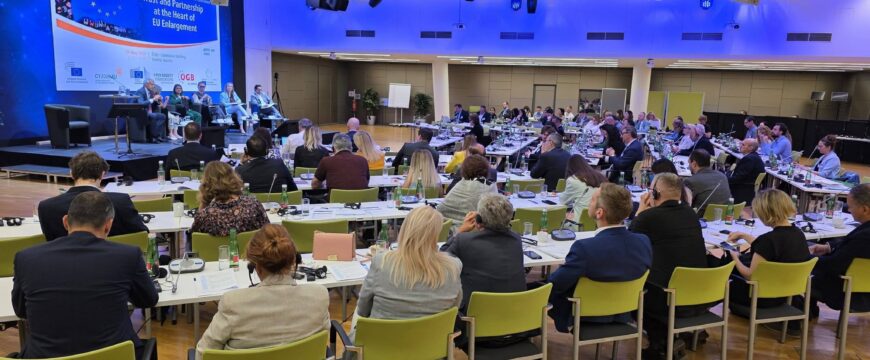
On 29 May 2026, a High-Level Civil Society Conference with the participation of the EU and the Western Balkans was held in Vienna, organized by the European Economic and Social Committee (EESC).
Mr. Angel Dimitrov, President of the Assembly of the Organization of Employers of Macedonia (OEM), participated in the conference as a representative of the Organization of Employers of Macedonia.
The main theme of the conference was: The Role of Civil Society in Advancing EU Enlargement, Strengthening Democratic Resilience, and Supporting Socio-Economic Convergence in the Region.
Within the framework of this main theme, discussions focused on trust, democracy, and civil society in the EU enlargement process; the enlargement of European security; the role of civil society in the Growth Plan for the Western Balkans; and the reform momentum and future Multiannual Financial Framework (MFF) support.
During the discussions, various opinions were expressed by representatives of the European Commission and EU Member States regarding how the evolving situation caused by the war in Ukraine and concerns over European security could influence the EU enlargement process for the Western Balkan countries.
It was also highlighted that Montenegro, North Macedonia, and Albania have achieved significant progress compared to the other candidate countries in implementing the Growth Plan.
The participants agreed that EU enlargement is a geostrategic investment in a stable, secure, and united Europe, and that a credible merit-based accession process remains one of the EU’s strongest tools for promoting democracy.
It was emphasized that credible progress in the areas of the rule of law, anti-corruption policies, media freedom, and the protection of fundamental rights remains essential for the legitimacy and sustainability of the enlargement process.
The participants noted that enlargement is a merit-based process and that, therefore, some candidate countries may progress faster than others. There is hope that Montenegro and Albania will maintain their positive pace, that Serbia, following the new elections, will restore trust in its democratic institutions, that North Macedonia and Bosnia and Herzegovina will soon be able to open the fundamental cluster of accession negotiations, and that Kosovo will obtain EU candidate status.
The participants called for intensified diplomatic efforts to resolve bilateral disputes, emphasizing that without the normalization of relations in the region, meaningful regional cooperation and a credible enlargement path will remain difficult to achieve.
It was further emphasized that the active involvement of social partners and civil society organizations, as well as the strengthening of their capacities, is crucial for improving the quality of social and civic dialogue and for the effective implementation and monitoring of reforms.